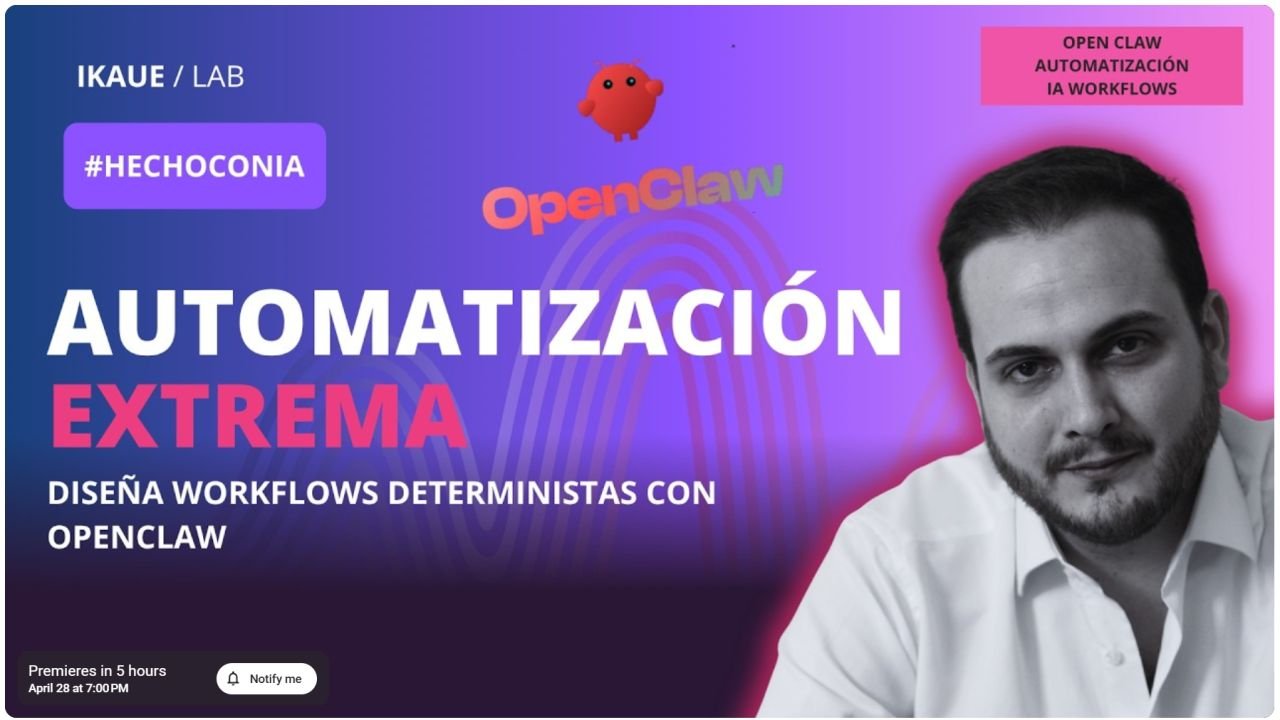
Recently I had the pleasure of chatting with Iñaki Huerta on his YouTube channel "Made with AI" about a topic I’m passionate about: how to take artificial intelligence from answering questions in a chat to agentic automation. In my more than 20 years in SEO and marketing, I have rarely seen a disruption as profound as the one we are experiencing now with AI and agents.
In the video I show how we can use OpenClaw not only as a personal assistant but as a highly configurable multi‑agent framework capable of handling complex, professional workflows.
What is OpenClaw really?
Many see OpenClaw as a simple “Jarvis” for everyday tasks, but its real power lies in being an open‑source package that connects large language models (LLM) with tools, memory systems, and task scheduling.
What makes it special is that it is model‑agnostic (you can use GPT, Claude, Gemini, or local models) and it can be installed on your own machine or server, giving it access to your files and any software you choose. You can also control it from your phone via Telegram, WhatsApp, Discord or iMessage, using voice or text.
Here’s the video; I think we had a very interesting conversation, and in it I was able to demonstrate a live demo of this agentic system:
The key: Hybrid Flows (Determinism vs. Non‑Determinism)
One of the main points we discuss is why 100% AI‑based automations often fail in production because of hallucinations. To solve this, I propose a hybrid approach in the video:
- Non‑Deterministic Flow: Pure AI, great for summarizing or reasoning, but with variable results.
- Deterministic Flow: Rule‑based scripts that produce predictable, auditable outcomes.
Within OpenClaw, tools like Lobster (for tool scripting) and LM Task (for controlled LLM calls) let us build pipelines where each step generates an “artifact” (JSON or CSV) that we can verify.
Case Study: Real‑time Trend Tracker
I showed how I configured "Jefry" (my personal assistant in OpenClaw) to run a trend‑search and automatic publishing routine:
- Data capture: The system browses Twitter and Google Trends using browsers with persistent sessions to avoid costly APIs and bypass anti‑bot blocks.
- Validation: Before publishing, the system performs fact‑checking and verifies style rules (title length, description, word count, etc.). If anything fails, the article stays in draft.
- Generative Factory: Content and images are generated by AI and sent to a ultra‑lightweight custom CMS I built. It produces 100% static HTML and uses only about 29 MB of RAM.
Memory Systems and the “Dreaming” Mode
OpenClaw manages information through multiple memory layers: daily or session memory, a general operational memory file MEMORY.md, and you can also enable Memory‑Wiki or other vector‑based RAG systems.
An especially interesting and relatively new feature is the “Dreaming” system, which runs at night when the system is idle, analyzes the day’s activity to find patterns and avoid errors, reorganizing its memory and evolving autonomously.
Tips if you’re going to work with these systems
If you’re starting with agentic systems, I suggest:
- Security first: Do not give your main accounts access; create dedicated emails and calendars for your agents and share access with permission controls.
- Focus on the “What”: Before crafting prompts, clearly define the process and the goal you want to achieve.
- Human talent: AI is an enhancer, not a total replacement. The final content should always undergo quality supervision.