
If you are still thinking of and using Artificial Intelligence as a simple chat where you enter a prompt to get text, I'm going to tell you bluntly: you are falling behind.
In 2026, we have experienced a revolution in both the tech industry and digital marketing. We moved from simple, stateless applications to dynamic, collaborative multi-agent ecosystems.
For digital marketing agencies and SEO professionals, this shift means the end of "prompt engineering" as a core skill, and the birth of agent orchestration. Now we are looking for autonomous systems that execute measurable business actions with high reliability.
What exactly is a Multi-Agent System?
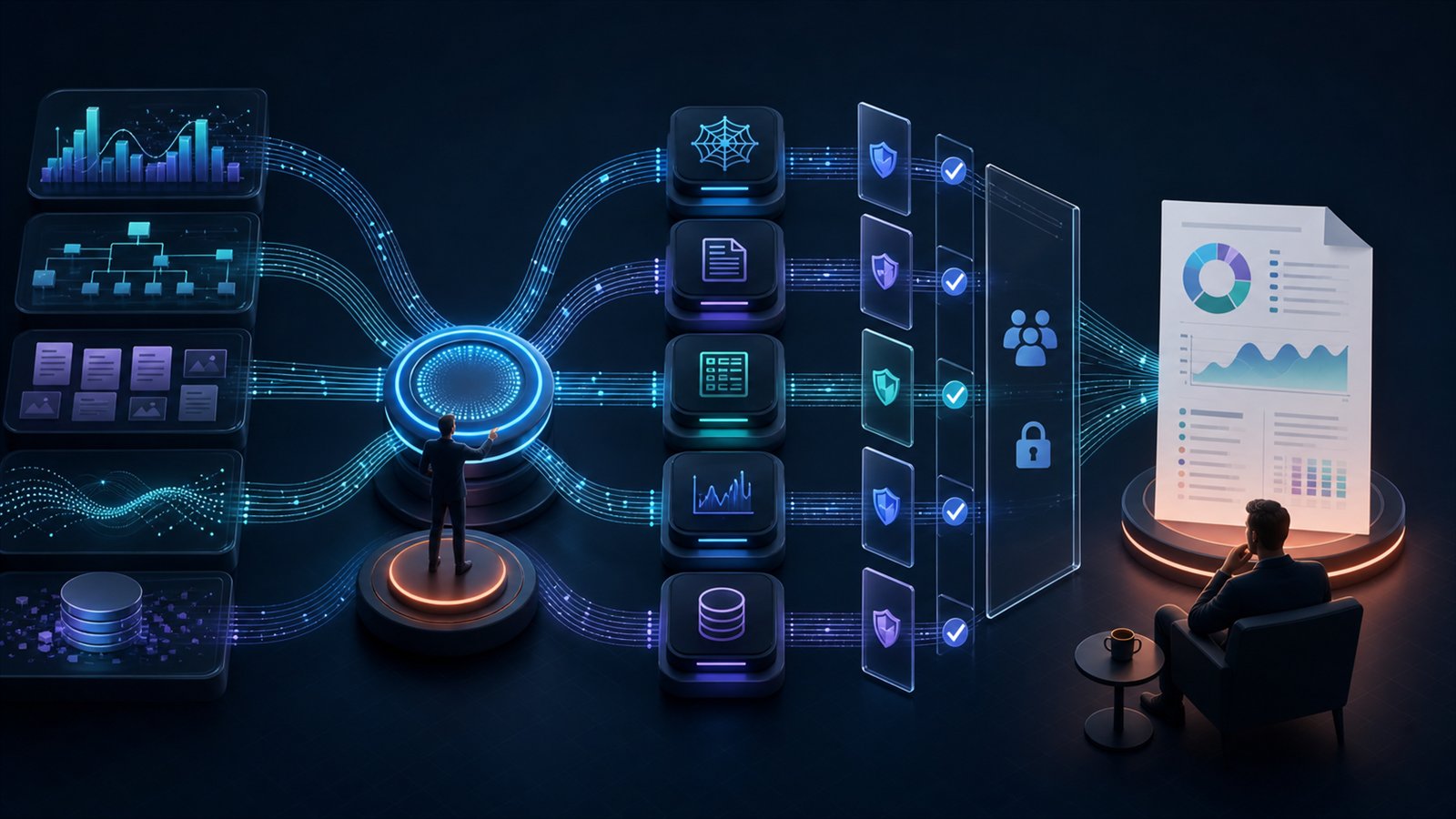
Instead of a single large language model (LLM) trying to do everything, a multi-agent system is a network of specialized agents cooperating with each other. They are capable of reasoning independently, planning multi-step workflows, using external tools, and iteratively self-correcting.
Think of it as a fully automated digital marketing agency. One agent researches trends and keywords, another writes the content respecting the defined editorial style, a third evaluates it against SEO quality metrics, and a fourth publishes it in the chosen formats and platforms, all without constant human intervention.
Best multi-agent AI tools, SDKs, and frameworks in 2026
Everything evolves so quickly, and it is so recent, that it's hard to keep up with the SDK ecosystem in 2026. What was considered "Top" 3 months ago is today considered outdated and obsolete. I am going to discuss some of the most powerful options I have tested, classified by their utility for digital operations:
1. CrewAI, n8n, and Openclaw: Low-Code and Roles
For marketing teams without a strong software engineering muscle, these are the crown jewels:
- CrewAI: Dominates the market for rapid prototyping. It allows modeling systems as if they were human organizational structures. You can create "crews" of agents by giving them specific roles, backstories, and goals. It's perfect for setting up a virtual team of writers, SEO analysts, and editors in less than an hour.
- n8n: A very good visual workflow engine. Through a visual canvas, you can connect agents with databases and APIs. It is ideal for building AI-driven "Sales Departments" or Automated "Report Generators", including human review nodes before sending emails to real clients.
- Openclaw: If CrewAI models teams and n8n connects workflows visually, OpenClaw takes it a step further. It is an open-source agent that orchestrates and executes real tasks on your computer and on the web, without you having to orchestrate every single step.
For agencies looking to replace a stack of paid tools with a configurable autonomous agent, OpenClaw is the most accessible option on the market today.
2. Paperclip: your own automated C-suite and Board
Paperclip handles orchestration as a business operations system run by autonomous agents. Instead of technical workflows, you build a corporate organizational chart. You can create a "CEO" agent that breaks down strategic guidelines and recruits subordinate agents for competitive intelligence, customer support triage, or content production tasks. In addition, you can assign each agent a fixed requests/tokens budget to prevent runaway API costs.
3. Vercel AI SDK: Connect your app/web to AI models
For web developers building custom platforms or CMS in React/Next.js, this SDK is amazing. It acts as an intermediary layer that abstracts the differences between providers (Google, OpenAI, or Anthropic) and incorporates "Evaluator-Optimizer" loops.
Marketing Use Case:
- Ad copy generation workflow or Adaptive Copies (Dynamic A/B Testing): One model writes the text and another immediately evaluates it against strict quality metrics (emotional appeal, tone and brand voice, keyword density, etc.). If it does not meet the threshold, the system iterates again autonomously until it reaches the goal. You can also create a workflow that generates multiple ad variations based on a structured schema (JSON). The SDK can analyze the customer profile and instantly generate the copy that best resonates with their interests to optimize conversion rates.
- Shopping Assistant with “Generative User Interface”: The SDK takes care of displaying dynamic visual components (product galleries, comparisons, etc.)
- Lead Qualification The agent automatically extracts and validates prospect data (using Zod). For example, detecting purchase intent, triggering an integrated tool to book meetings.
4. PydanticAI: Absolute Determinism for Programmatic SEO
In SEO, data structure (JSON-LD, Schema) leaves no room for error. AI hallucinations can be catastrophic. PydanticAI reduces AI unpredictability and forces any agent output data to meticulously conform to predefined and typed JSON schemas. If you extract data for programmatic SEO or PPC campaigns, it offers you more security by default.
5. OpenAI Agents SDK: Orchestration with native handoffs and guardrails
Released in March 2025 as a replacement for the experimental Swarm. OpenAI's Agents SDK is today one of the most mature options for building multi-agent systems in production. Its core abstraction is the handoff (agents explicitly transfer control to each other, carrying the conversation context through each transition). This facilitates triage-type architectures, where an orchestrator agent receives the task, determines its nature, and delegates it to the corresponding specialized agent (support, sales, content...).
The SDK includes three primitives that make it especially robust for production environments:
- Handoffs for delegation between agents
- Guardrails to validate inputs and outputs at each step
- Tracing to have end-to-end observability of the entire agent chain.
More recently, OpenAI complemented the SDK with AgentKit, which adds a visual canvas to design and version multi-agent workflows (Agent Builder), and a toolkit to embed agent interfaces directly into your products (ChatKit).
In principle, it is provider-agnostic (more than 100 LLMs supported), although it is designed for OpenAI models.
For marketing teams with technical muscle who need reliability and traceability, it is one of the most solid bets in the ecosystem.
6. Claude Agent SDK: The infrastructure of Claude Code, open for developers
Anthropic launched the Claude Agent SDK in September 2025. The conceptual difference from other SDKs is significant; it is not just an orchestration layer, but a complete harness. Claude autonomously manages the tool execution loop. You define the goal and permissions, and the agent decides how to use the available tools to achieve it, without you having to program each step of the cycle.
It features native integration with MCP (to connect agents with external tools), support for sub-agents, and structured outputs with JSON schema validation. For programmatic SEO operations or data extraction, this allows combining the power of the agent with typed and reliable outputs.
But it has several disadvantages: YOU CANNOT use models from other providers, you are bound to Anthropic. It does not include state persistence between sessions, nor integrated observability as standard, so in complex architectures, you will need to complement it with external monitoring tools.
Even so, for teams already working with Claude who want to transition from manual prompts to automated agentic workflows, it is the natural and most direct path.
7. LangGraph
A pioneering and already veteran system (it seems incredible that something launched less than a year ago is already considered a veteran), it is a multi-agent orchestration engine with state graphs, cycles, and conditional branching. It is more laborious and complex to implement than newer solutions, but one of the most solid.
8. Enterprise or "Turnkey" Solutions
Such as Microsoft's AutoGen, which is based on an event-driven architecture. It was one of the pioneering frameworks to popularize multi-agent orchestration, born as a research project at Microsoft Research.
Its approach is unique because it models everything as conversations between agents. There are no state graphs or formal roles. Agents take turns sending each other messages in natural language, and coordination emerges from that dialogue. It shows that it was one of the first, and the foundations of agentic systems were not yet very clear.
AutoGen is currently in maintenance mode; it will not receive new features and is now managed by the community. So you should start directly with the new Microsoft Agent Framework.
Microsoft Agent Framework: It combines the simple abstractions of AutoGen with the enterprise features of Semantic Kernel:
- Session state management
- Type safety
- Middleware
- Telemetry
- Extensive model support
It also adds graph-based workflows for explicit multi-agent orchestration and is designed to integrate with Azure AI Foundry for production deployment and monitoring.
Future of SEO and Digital Marketing in 2026
For digital marketing and SEO agencies, the competitive advantage no longer lies in knowing what prompt to write in ChatGPT. Instead, it lies in knowing which SDK to use, how to structure agent teams and workflows (either visually with n8n or programmatically with LangGraph), and how to do it safely, deterministically, and in compliance with current regulations.
The future is already here, and it is multi-agent.